 Four-Faith IoT

F-LD100 Integrated Radar Water Level Gauge
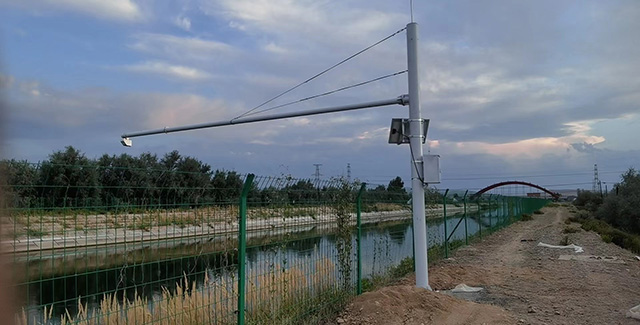
The F-LD100 is a 24 GHz millimeter-wave FMCW non-contact water level monitoring device with a maximum measuring range of 70 m. An optional RTU module enables data acquisition, storage and wireless transmission. It is widely used for hydrological monitoring in rivers, reservoirs and channels. This guide covers the device's key parameters, installation essentials, RTU functions and Modbus communication details to support on-site deployment and commissioning.
Key Parameters
The device uses FMCW (Frequency Modulated Continuous Wave) radar ranging with a measurement accuracy of ±1 mm, a resolution of 1 mm and a blind zone of ≤4 cm. It is powered by DC 6–36 V, operates over −35 °C to +75 °C, is rated IP68, and weighs approximately 1 kg. In gauge mode, sleep current is < 1.3 mA, making the low-power design well suited to remote unattended field deployments. With the optional RTU module, the device supports 2G/3G/4G and Bluetooth 4.2, can connect external rain gauges and analog sensors, and stores over 100,000 historical records locally.
Installation Essentials
During installation, keep the antenna plane parallel to the water surface, prioritize calm water areas and avoid floating debris. The radar beam angle is 11°, with the illuminated area approximated by A ≈ 0.193H, where H is the height from the antenna to the channel bottom. The channel width must exceed the illumination diameter to prevent interference from the bank walls. Install the device at the center of the channel cross-section so that the beam does not hit the banks when the water level drops. Secure the device with the dedicated mounting bracket, and make sure the SMA antenna is tightened properly. Insert the SIM card into the drawer-type slot with the metal contacts facing outward. Wire the COM1 and COM2 aviation connectors strictly according to the cable color coding to prevent wiring errors that could damage the device.
RTU Working Modes
The RTU supports two working modes: report mode and compatible mode. In report mode, the device transmits only on a scheduled or event-triggered basis, keeping sleep power consumption low. In compatible mode, the device remains always online and supports platform on-demand interrogation, at the cost of higher power consumption. The device supports threshold alarms, remote firmware upgrades and parameter configuration, and historical data can be exported to Excel via the serial port.
Modbus Communication
Communication uses the RS485 Modbus protocol with a default address of 01 and a baud rate of 115200. Function code 03 reads holding registers to obtain water level and empty height, 04 reads input registers, and 06 modifies the device address. Water level and empty height are 32-bit floating-point values. For commissioning, the device can be accessed via Bluetooth or an RS232 interface, and address and baud rate changes take effect immediately.